Short answer
Judge vehicle cleanup technology by whether it reaches where contamination actually sits, whether it is used after hands-on cleaning rather than instead of it, what it does to automotive materials and electronics, and how results are verified. Extraction, inspection tools, and registered disinfectants do most of the work. Foggers, UV devices, steam, and ozone can help as follow-up steps when a provider explains why they fit.
Why cleanup technology is hard to evaluate
Vehicle interiors are cramped, layered, and packed with electronics. Foam sits under fabric, carpet hides padding and wiring harnesses, and air ducts wind behind the dashboard. That makes it tempting to believe a machine can reach everywhere a technician's hands cannot.
Many products are sold to detailers, fleets, and cleanup companies with claims about killing germs or erasing odors in minutes. Some of those tools have real value. Others are designed for routine sanitizing between passengers, not for blood or bodily fluid that soaked into a seat.
The simplest way to judge any tool is to ask where the contamination is, whether the tool can reach it, and what the tool leaves behind in a small, closed cabin full of plastics, leather, and circuit boards.
Tools that find contamination
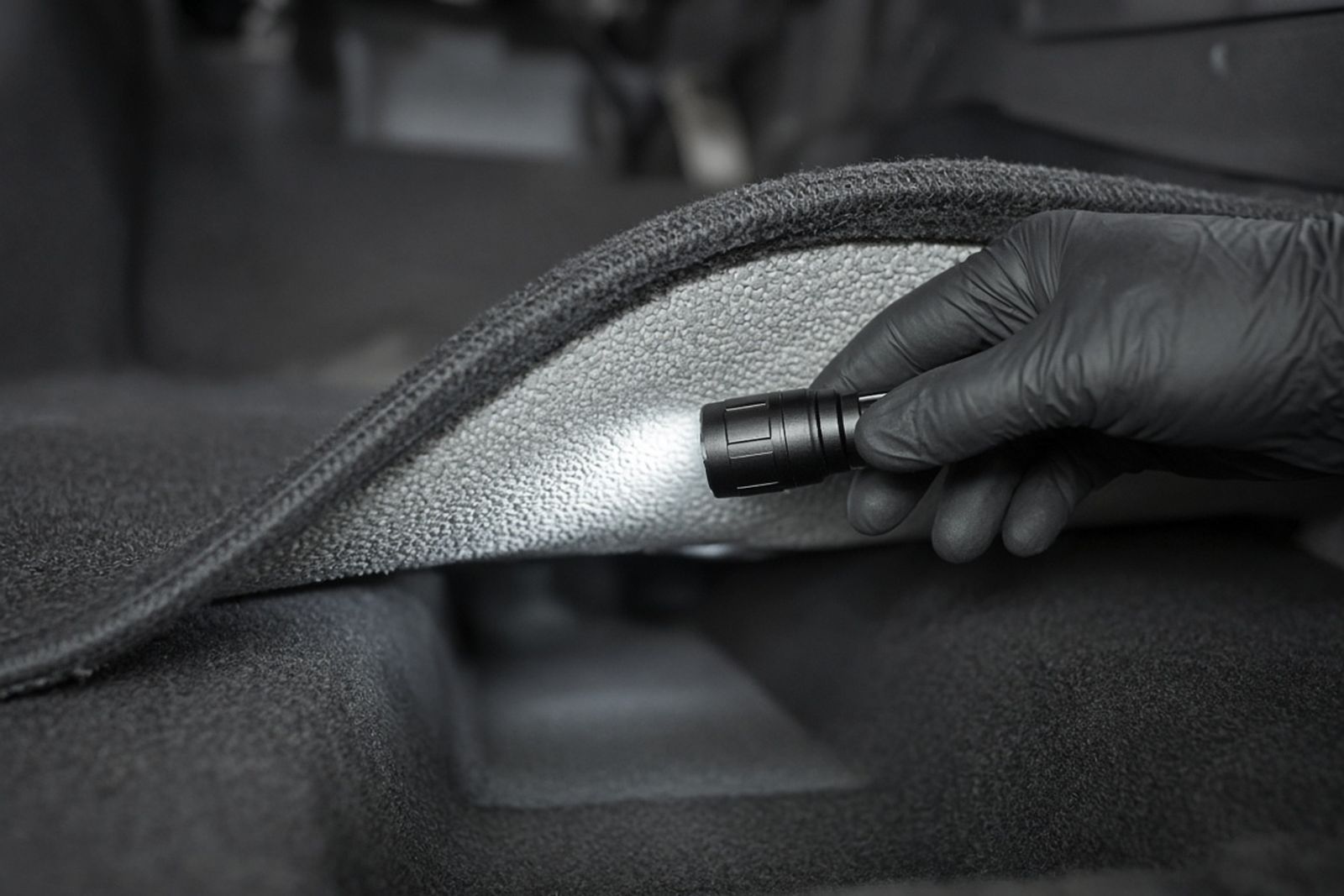
Inspection tools make the rest of the job possible. Bright, color-accurate work lights reveal staining on dark carpet and upholstery. UV flashlights help locate some organic residues. Borescopes and inspection cameras let technicians see under seats, inside door cavities, and along seat rails without removing everything first.
Moisture meters show whether padding and floor insulation are still wet after fluid soaked in. That matters because wet padding cannot simply be dried in place when it holds biological material, and it tells the technician how far fluid spread.
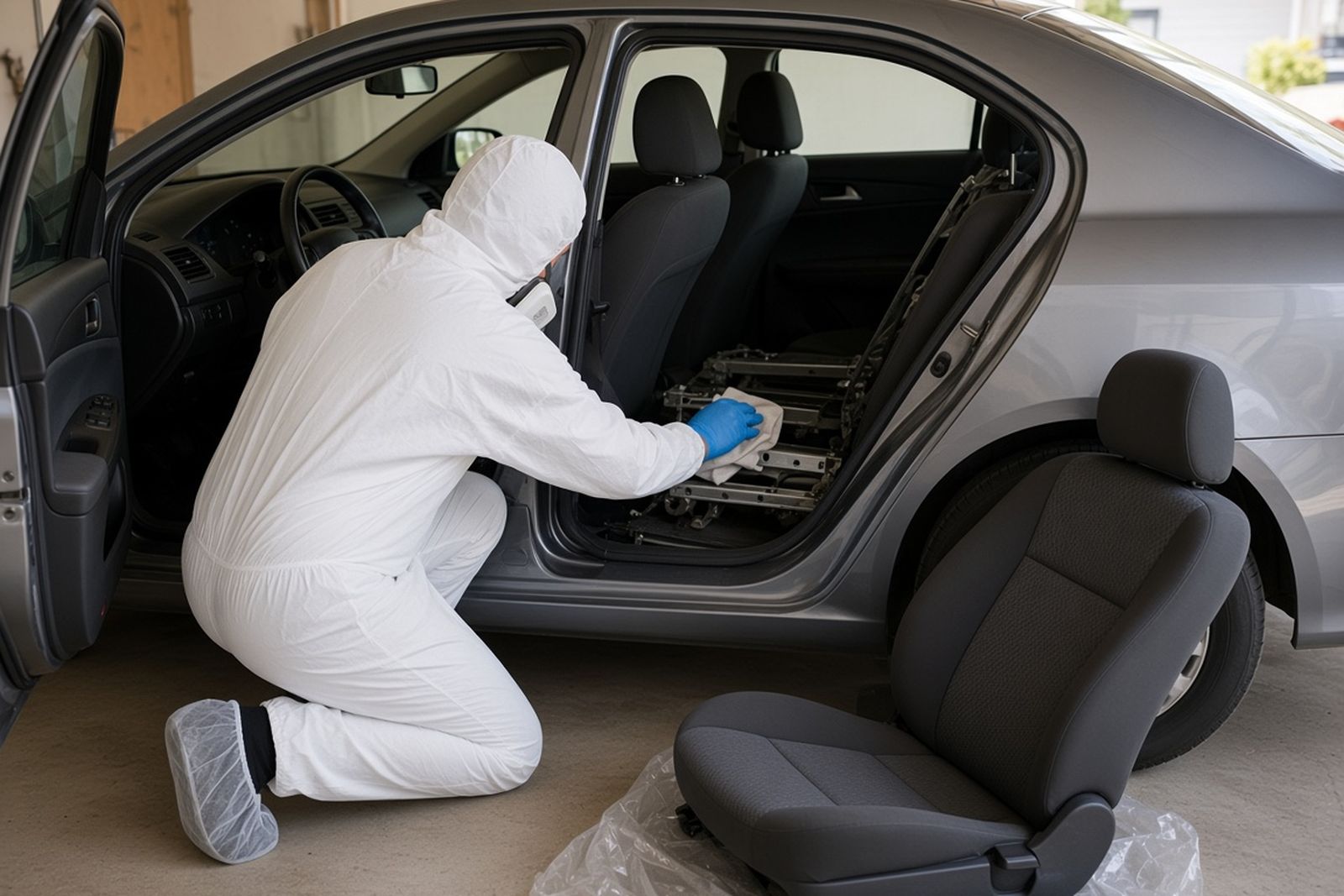
Trim removal tools and the correct sockets for seat bolts are not high technology, but a provider who has them and knows how to use them will inspect more thoroughly and damage less.
- Work lights and UV lights: visible and hidden staining
- Borescopes: under seats and inside panels
- Moisture meters: how far fluid traveled
- Proper trim and seat tools: safe access without damage
Tools that do the real cleaning
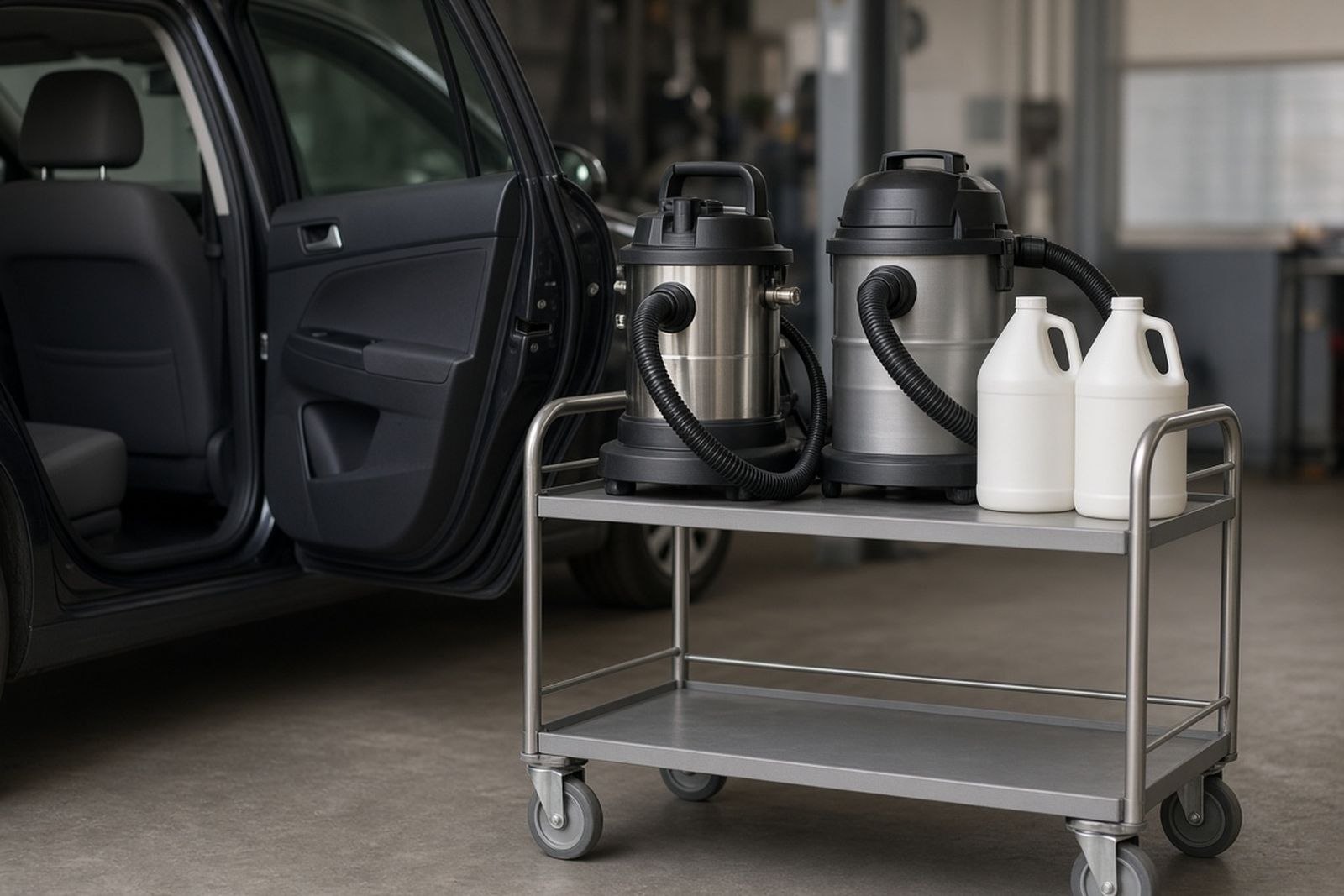
Hands-on removal and cleaning drive the outcome. Hot water extractors with upholstery and crevice tools flush and pull contaminated liquid from fabrics that can be saved. Wet vacuums capture rinse water so it does not spread. Soft brushes and detail tools reach seams, stitching, and switch gaps.
Steam cleaners can help loosen residue from hard surfaces and seams and add heat to the process. They must be used carefully around electronics, airbag modules, and delicate trim, and they do not replace a registered disinfectant applied at label contact time.
Research on emergency vehicles shows why method matters. A 2015 study by Valdez and colleagues found that existing decontamination left 26 of 48 sites tracer-positive in an ambulance simulation. The takeaway for any vehicle is that routine wiping alone can miss a lot, and thorough, methodical technique counts more than any single product.
Foggers and electrostatic sprayers
Foggers and electrostatic sprayers spread disinfectant or deodorizer in fine droplets that can reach surfaces hand application misses, such as the headliner, vents, and the backs of seats. Electrostatic units charge droplets so they wrap around surfaces more evenly.
Whole-cabin treatments show measurable effects in studies of larger vehicles. A 2022 study by Kruszewska and colleagues on peracetic acid fumigation reported an overall reduction of 66.5% in coaches. That is a meaningful drop, but it is not elimination, and it was measured across general surfaces rather than a spot soaked with blood.
In a biohazard job, fogging belongs after saturated materials are removed and surfaces are cleaned and disinfected by hand. Ask what product is being applied, whether it is registered for the intended use, and how the provider protects electronics and screens from moisture.
UV light in a vehicle cabin
Ultraviolet devices can inactivate some microorganisms on surfaces the light directly reaches. In a vehicle, that is the problem. Seats, consoles, and door pockets create shadows, and UV does not penetrate fabric, foam, or dried residue.
UV may have a place as an added step on hard, exposed surfaces after cleaning, or inside a duct during HVAC treatment where a device is designed for that purpose. It cannot address blood in seat foam or fluid in carpet padding.
Strong UV sources can also harm eyes and skin and fade some interior materials. Any provider using UV should explain how they protect people and the vehicle.
If a provider offers UV as a selling point, ask how long each surface is exposed, how they deal with shadowed areas, and what cleaning happens first. Honest answers will describe UV as an extra layer, not the main event.
Ozone and other odor machines
Ozone generators are common in auto detailing because a closed car is easy to treat. Ozone can reduce some odors once the source is gone. It also degrades rubber seals, wiper blades, some plastics, and certain fabrics with repeated or heavy exposure, and it must be fully aired out before anyone drives the vehicle.
Chlorine dioxide products and enzyme foggers offer other options for odor after cleanup. Each has its own label directions and material cautions. The right choice depends on what caused the odor and what materials remain in the cabin.
HVAC systems deserve special attention. A 2025 study of five South Korean emergency ambulances found that all six high-touch surfaces tested were contaminated before daily disinfection, with ventilation outlets carrying the highest bacterial counts. For any vehicle, that points to replacing the cabin air filter and treating vents rather than relying on a machine to push air through dirty ducts.
How a careful provider tests a new tool
A careful provider trials a new tool before it sells it. Suppose a vendor offers a handheld electrostatic sprayer paired with a new disinfectant and claims it cuts cleaning time for vomit calls in half. The sensible response is to keep the normal process on the next several calls: remove affected mats, extract fabric, clean hard surfaces, and disinfect by hand, then add the sprayer as a final step on half of the vehicles.
Swabbing the same set of hard surfaces before cleaning, after hand work, and after spraying, and logging the time spent, shows what the tool really adds. If it offers only a small improvement on hard-to-reach surfaces like seat backs and door pockets without saving time, because hand cleaning is still required, it belongs as an optional final step rather than a shortcut.
A trial also surfaces side effects, such as a disinfectant film on touchscreen displays, that the written procedure then has to address before the tool goes into regular use.
Does technology change what gets removed?
No tool on the market reliably cleans blood out of saturated seat foam, carpet padding, or seat belt webbing. Those items still need to be removed and replaced when fluid reached them. Be cautious of anyone who promises that a machine will save a soaked seat.
Technology can make removal decisions more precise. Inspection cameras and moisture meters help technicians see exactly how far contamination spread, which may mean replacing one seat cushion instead of an entire row. That is where innovation offers real savings.
Replacement parts carry their own considerations. Seats with occupancy sensors, airbags, and heating elements need proper installation and a check for warning lights afterward.
Tools that help verify the work
Verification technology has improved and become more affordable. ATP meters give quick readings of organic residue on hard surfaces, which lets technicians compare before and after results on the same spot. Digital photo logs with timestamps and location notes create a record that insurers and fleet managers can review.
Some providers use small data loggers to track temperature and humidity while a vehicle dries, which confirms that the floor pan and remaining materials are dry before carpet goes back in. Others use diagnostic scan tools after reassembly to confirm that seat and airbag systems report no faults.
None of these tools can declare a cabin free of every pathogen, and none measures odor directly. The final odor check still depends on closing the vehicle in warm conditions and having someone with a fresh nose open it. Used together, though, verification tools turn a verbal assurance into a documented result.
What should I ask about equipment?
When a provider mentions special equipment, ask what it does for your specific situation. Ask whether it is used instead of hands-on cleaning or after it. Ask what product it applies, whether that product is registered for the intended use, and what the label says about contact time and materials.
Ask how they protect electronics, screens, and airbag components. Ask how the result will be checked, whether through visual inspection, swab readings, an odor test in warm conditions, or a combination.
Ask how removed parts and waste will be handled. Seats, carpet, and absorbent materials that contain blood or other potentially infectious materials may be regulated waste, so ask where they will go and what record you will get.
Sources
- Valdez et al. — Spread of infectious microbes during emergency medical response
- Kruszewska et al. — Is Peracetic Acid Fumigation Effective in Public Transportation?
- International Journal of Emergency Medicine — Preliminary investigation of bacterial surface contamination in emergency ambulances in South Korea